I think, the biggest challenge for people coming to such huge events as Oracle OpenWorld is to navigate through all of the events that simultaneously happen at various locations. You are always under stress that you may miss something, or that you may hit a bad talk, or that you may not even know that there was a talk directly linked to your key production problems.
Finally there is a real guide to OpenWorld - and I am very pleased have one of my presentations listed there:
http://www.otechmag.com/2014/otech-magazine-fall-2014/
Looking forward to see everybody in San Fran!
Thursday, September 25, 2014

Friday, September 19, 2014
My new book
It seems to me that I talked about my most recent book everywhere except for my own blog... So, let me introduce you to the one and only performance tuning book dedicated to PL/SQL:
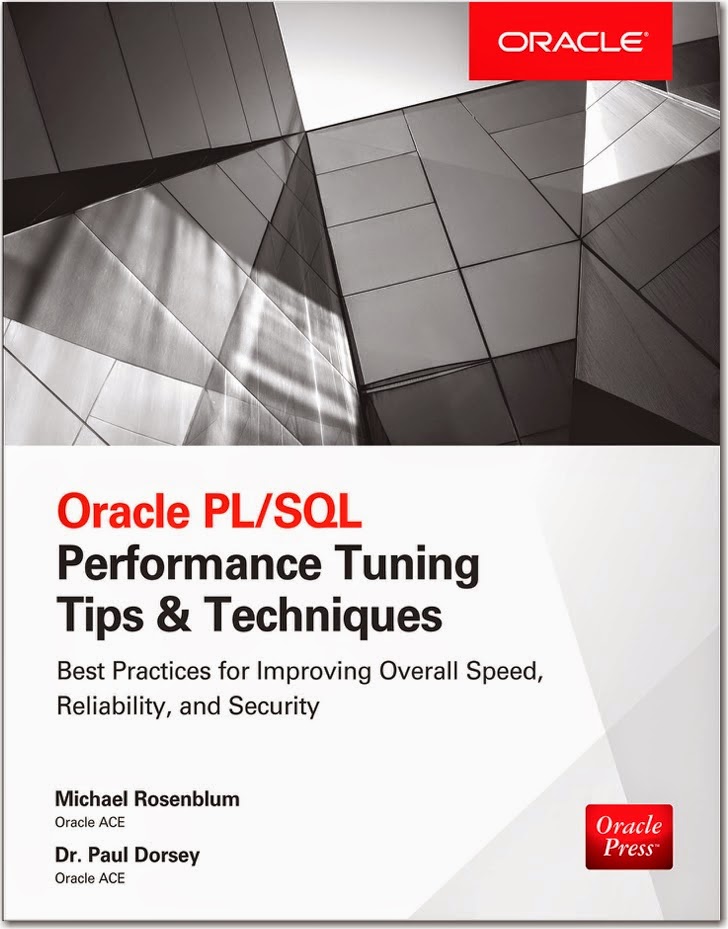
This book took me much longer to write than I initially anticipated - and to be fair, that's the reason for staying quiet at the blog. I just didn't have time/energy to write everywhere :-) Although, it was fun writing - I finally got a chance to create a digest of my own knowledge and put it into any format I choose to. Of course, some shaping from my esteemed guru and co-author Dr. Paul Dorsey was definitely needed, but still it was as free-form as you get. Publishers trusted us so much that they didn't attach any strings to the contract - we were reshaping the structure of the book up to the very end.
I think, I did my best and reached the goal I was shooting at. I really hope, this book can help a lot of people to build better software. Now it's your turn to tell me whether I was right or wrong.
P.s. Here is a review from Steven Feuerstein - link.
This book took me much longer to write than I initially anticipated - and to be fair, that's the reason for staying quiet at the blog. I just didn't have time/energy to write everywhere :-) Although, it was fun writing - I finally got a chance to create a digest of my own knowledge and put it into any format I choose to. Of course, some shaping from my esteemed guru and co-author Dr. Paul Dorsey was definitely needed, but still it was as free-form as you get. Publishers trusted us so much that they didn't attach any strings to the contract - we were reshaping the structure of the book up to the very end.
I think, I did my best and reached the goal I was shooting at. I really hope, this book can help a lot of people to build better software. Now it's your turn to tell me whether I was right or wrong.
P.s. Here is a review from Steven Feuerstein - link.
Monday, September 15, 2014
Good sources of Oracle information
Pretty often I am being asked about various online and printed source of Oracle-related information. Finally I decided to create a blog post here where I will start to accumulate all the goodies that I just "happen" to find. Maybe I will eventually create even some kind of a guide... Let's see.
Before we start - a couple of disclaimers:
* It is my personal list of favorite resources, so all of the following statements assumed to be prefixed with IMHO :-)
* The list represents my own interests, which are somewhat between DBA and Developer lands (plus a bit of Architect).
* I highly value printed books, because while working on them authors structure (and check!) the material much better comparing to blogs. So, if I mention a name below, you also should check his/her books - they will be worth your money. Even blogs have the advantage of being more interactive (you may get immediate feedback), the quality of books should not be underestimated.
Ok, let's start:
1. My gurus (overall)
- Tom Kyte asktom.oracle.com - no extra explanations needed, I hope ;-)
- Steven Feuerstein http://www.stevenfeuerstein.com/ - one of the main faces behind PL/SQL for the last 20 years
- Jonathan Lewis http://jonathanlewis.wordpress.com/ - after his explanations I finally started to get the Cost-Based Optimizer
- Daniel Morgan http://www.morganslibrary.org/ - huge collection of useful articles and examples! Often more understandable than original Oracle docs.
2. My teachers in the field of performance tuning
- Tanel Poder http://blog.tanelpoder.com/ - I've seen him reading raw trace files! He can decipher X$-objects too.
- Cary Millsap http://carymillsap.blogspot.com/ - extremely rare case of holistic approach to performance tuning (Method-R!)
- Craig Shallahamer http://shallahamer-orapub.blogspot.com/ - another example of very scientific approach to tuning
- Chris Antognini http://antognini.ch/blog/ - a lot of depth in understanding of how Oracle internals work together.
3. My fellows. They do the same kind of job as I do (only sometimes better!)
- Tim Hall http://www.oracle-base.com/
- Adrian Billington http://www.oracle-developer.net/
- Alex Nuijten http://nuijten.blogspot.com/
- Rob van Wijk http://rwijk.blogspot.com/
- Marco Gralike http://www.liberidu.com/blog/
4. DBAs land
- Arup Nanda http://arup.blogspot.com/.
- Alex Faktulin http://afatkulin.blogspot.com/
- Company blog (a lot of smart people up there!): http://www.pythian.com/blog/ Just to name a few: Alex Gorbachev, Michael Abbey, Christo Kutrovski, Jared Still, etc.
Before we start - a couple of disclaimers:
* It is my personal list of favorite resources, so all of the following statements assumed to be prefixed with IMHO :-)
* The list represents my own interests, which are somewhat between DBA and Developer lands (plus a bit of Architect).
* I highly value printed books, because while working on them authors structure (and check!) the material much better comparing to blogs. So, if I mention a name below, you also should check his/her books - they will be worth your money. Even blogs have the advantage of being more interactive (you may get immediate feedback), the quality of books should not be underestimated.
Ok, let's start:
1. My gurus (overall)
- Tom Kyte asktom.oracle.com - no extra explanations needed, I hope ;-)
- Steven Feuerstein http://www.stevenfeuerstein.com/ - one of the main faces behind PL/SQL for the last 20 years
- Jonathan Lewis http://jonathanlewis.wordpress.com/ - after his explanations I finally started to get the Cost-Based Optimizer
- Daniel Morgan http://www.morganslibrary.org/ - huge collection of useful articles and examples! Often more understandable than original Oracle docs.
2. My teachers in the field of performance tuning
- Tanel Poder http://blog.tanelpoder.com/ - I've seen him reading raw trace files! He can decipher X$-objects too.
- Cary Millsap http://carymillsap.blogspot.com/ - extremely rare case of holistic approach to performance tuning (Method-R!)
- Craig Shallahamer http://shallahamer-orapub.blogspot.com/ - another example of very scientific approach to tuning
- Chris Antognini http://antognini.ch/blog/ - a lot of depth in understanding of how Oracle internals work together.
3. My fellows. They do the same kind of job as I do (only sometimes better!)
- Tim Hall http://www.oracle-base.com/
- Adrian Billington http://www.oracle-developer.net/
- Alex Nuijten http://nuijten.blogspot.com/
- Rob van Wijk http://rwijk.blogspot.com/
- Marco Gralike http://www.liberidu.com/blog/
4. DBAs land
- Arup Nanda http://arup.blogspot.com/.
- Alex Faktulin http://afatkulin.blogspot.com/
- Company blog (a lot of smart people up there!): http://www.pythian.com/blog/ Just to name a few: Alex Gorbachev, Michael Abbey, Christo Kutrovski, Jared Still, etc.
Friday, September 12, 2014
Analytic functions in real life
Yesterday while working on a real production report I found a requirement that forced me to come up with a bit nontrivial usage of analytic functions. Here is the problem (translated to SCOTT-level terms):
- I have a table that contains a DATE column (HIREDATE)
- Input parameter is also a date (IN_DT)
- For each department I need to show all rows that have HIREDATE after IN_DT plus the most recent row from the past (only one!).
Obviously, if you split the last condition into two, the solution is reasonably clear:
SELECT empno, ename, deptno, hiredate
FROM scott.emp
WHERE hiredate>:IN_DT
UNION ALL
SELECT empno, ename, deptno, hiredate
FROM (
SELECT e.*,
row_number()
over(PARTITION BY deptno
ORDER BY hiredate desc,
empno desc
) rank_nr
FROM scott.emp e
WHERE hiredate<=:IN_DT
)
WHERE rank_nr = 1
The only problem of this solution - it needs two passed over EMP table. But in my production case that table is huge. Also, just to make life interesting, the result of the specified query has to be joined to 8 other tables to provide the required output. It is understandable, that my first optimization idea was to somehow do a single-pass query. To my own surprise, Oracle analytic functions are flexible enough to help me out:
SELECT empno, ename, deptno, hiredate, rank_nr
FROM
(
SELECT e.*,
dense_rank()
over(PARTITION BY deptno
ORDER BY
CASE WHEN hiredate > :IN_DT THEN '9999'
ELSE to_char(hiredate,'YYYYMMDDHH24MISS')||
lpad(empno,10,'0')
END desc
) rank_nr,
max(hiredate)
over(
PARTITION BY deptno) max_dt
FROM scott.emp e
)
WHERE max_dt > :IN_DT AND rank_nr IN (1,2)
OR
max_dt < = :IN_DT AND rank_nr = 1
- I have a table that contains a DATE column (HIREDATE)
- Input parameter is also a date (IN_DT)
- For each department I need to show all rows that have HIREDATE after IN_DT plus the most recent row from the past (only one!).
Obviously, if you split the last condition into two, the solution is reasonably clear:
SELECT empno, ename, deptno, hiredate
FROM scott.emp
WHERE hiredate>:IN_DT
UNION ALL
SELECT empno, ename, deptno, hiredate
FROM (
SELECT e.*,
row_number()
over(PARTITION BY deptno
ORDER BY hiredate desc,
empno desc
) rank_nr
FROM scott.emp e
WHERE hiredate<=:IN_DT
)
WHERE rank_nr = 1
The only problem of this solution - it needs two passed over EMP table. But in my production case that table is huge. Also, just to make life interesting, the result of the specified query has to be joined to 8 other tables to provide the required output. It is understandable, that my first optimization idea was to somehow do a single-pass query. To my own surprise, Oracle analytic functions are flexible enough to help me out:
SELECT empno, ename, deptno, hiredate, rank_nr
FROM
(
SELECT e.*,
dense_rank()
over(PARTITION BY deptno
ORDER BY
CASE WHEN hiredate > :IN_DT THEN '9999'
ELSE to_char(hiredate,'YYYYMMDDHH24MISS')||
lpad(empno,10,'0')
END desc
) rank_nr,
max(hiredate)
over(
PARTITION BY deptno) max_dt
FROM scott.emp e
)
WHERE max_dt > :IN_DT AND rank_nr IN (1,2)
OR
max_dt < = :IN_DT AND rank_nr = 1
In this solution I two analytical functions
1. DENSE_RANK is forced to order in the following way:
- bring all future dates to the top by assigning them exactly the same value '9999'
1. DENSE_RANK is forced to order in the following way:
- bring all future dates to the top by assigning them exactly the same value '9999'
- order all other dates by converting them to 'YYYMMDDHH24MISS' format. In that format DESC would bring the most recent date up anyways.
- to resolve conflicts of multiple entries associated with the same date concatenate past dates with padded EMPNO. This way textual sort would correctly work even if the length of EMPNO may differ.
2. MAX() OVER() brings the highest hire date for each department.
Now the outer SELECT has enough information to filter out correct rows: if the highest date if after the parameter, you need to bring ranks 1 and 2 (all future dates + the last past date). Otherwise you need only rank 1 (last past date).
I understand, that this solution may take a couple of seconds to wrap your head around :-). Still - I was able to do exactly what I needed in a single pass!
Summary: if you are working on reports, analytic function is the MUST. That's the only safe way to write efficient code that would consistently work over large data sets.
Summary: if you are working on reports, analytic function is the MUST. That's the only safe way to write efficient code that would consistently work over large data sets.
Tuesday, September 9, 2014
Oracle OpenWorld 2014
Less than 3 weeks left before the biggest Oracle event of the year kicks in - and I bet, Oracle OpenWorld'14 will impress anybody (as usual). I am honored to be selected as one of speakers there. Here are my two talks:
- UGF4428 "Expanding SQL Horizons: PL/SQL User-Defined Functions in the Real World"
Sunday, Sep 28, 1:30 PM - 2:15 PM
Moscone South - 310
- CON4429 "Calling SQL from PL/SQL the Right Way"
Thursday, Oct 2, 2:30 PM - 3:15 PM
Moscone South - 308
Everybody is welcome! I really think that these presentations can improve you day-to-day PL/SQL.
P.s. I will do my best to provide a daily update from the ground! There should be a lot of interesting things to share.
- UGF4428 "Expanding SQL Horizons: PL/SQL User-Defined Functions in the Real World"
Sunday, Sep 28, 1:30 PM - 2:15 PM
Moscone South - 310
- CON4429 "Calling SQL from PL/SQL the Right Way"
Thursday, Oct 2, 2:30 PM - 3:15 PM
Moscone South - 308
Everybody is welcome! I really think that these presentations can improve you day-to-day PL/SQL.
P.s. I will do my best to provide a daily update from the ground! There should be a lot of interesting things to share.
Wednesday, August 20, 2014
Time to resurrect blogging!
Sorry for staying quiet for some time, but for some good reasons. Some of these reasons will be explained in later posts, but for now I would like to share the story I wrote upon request of Steven Feuerstein, who asked to tell how PL/SQL impacted our life. Here is my story:

-----------------
I started to work with databases already in college, but more from the data modelling/business analysis angle. When I moved to the USA in 2000 (just after graduation) I quickly recognized that my language skills are too limited to work as BA, so I went to evening Oracle courses in Philadelphia to deepen by technical skills – SQL, PL/SQL, SQL*Plus, into to administration etc.
And suddenly I realized that I like it even more than playing with ERDs! Also, a bit of a lucky break – one of my teachers recommended me to his former boss. To be fair, I have no idea how I survived that interview – somewhere in the middle of it I realized that this boss is no less than Dr. Paul Dorsey, whose book I was recently quoting in my Master Degree Thesis… Anyways, on February 26th, 2001 Dulcian Inc got a brand new 21-year-old employee with the focus on database development.
And couple of months later I’ve got a task that really shaped my specialization: I needed to write a module that would check for invalid objects in the schema and compile them in the appropriate order of dependencies. So, the set of tools is obvious (now), but at that time I had to discover: data dictionary views, object collections, recursion, and, finally, Dynamic SQL. For my reader/listeners – that list sounds really familiar, isn’t? :-) Looks like Oracle versions change, but favorite toys stay the same!
After that module started to work (I think, even Dr. Paul got surprised!) my field was settled: solving strange/unsolvable database problems using SQL and PL/SQL. That’s pretty much what I still do now – even 14 years later. Bad news – there are lots of such problems. Good news – it’s fun to solve them (and that’s the way I get new stories for books/presentations!)
---------------------
Not exactly a fairy tale, but it definitely shows that you never know how your career will move forward, especially just after college. By the way, I brought with me to the USA that Russian-translated book by Dr. Paul! It stays right now in the office together with other memorabilia. Here is the scan:
Tuesday, September 3, 2013
Unknown DATAPUMP functionality: getting catalog from the file
To be fair, I am not spending all of my days writing the new PL/SQL book :-) I even work sometimes! And while solving real problems I reasonably often find interesting thing.
Today I was asked by one of my colleagues: is it possible to look inside of the existing DATAPUMP file. This file was a FULL import of client's database, and we needed to check for the existence of a very specific public synonym.
The question was perfectly valid and I started the research. First, I found that IMPDP has parameter SQLFILE=<filename>, that generates all DDL from the dump. It could work out, but the perspective of digging through megabytes of textual data was not very promising, so I continued my research.
Eventually I found a comment in of Oracle-related forums mentioning another IMPDP parameter: MASTER_ONLY=YES. We all know that every time you run IMPDP, it creates a special table that contains the catalog of objects to be processed (names like SYS_IMPORT_TABLE_##, SYS_IMPORT_SCHEMA_##, SYS_IMPORT_FULL_##). As it appears to be, this catalog is human-readable (mostly)! The parameter mentioned above just loads this table - and stops at this point:
C:\>impdp system/system@testDB dumpfile=StrangeFile.dmp logfile=imp_master.log master_only=yes full=y
Import: Release 11.2.0.3.0 - Production on Tue Sep 3 13:09:15 2013
Copyright (c) 1982, 2011, Oracle and/or its affiliates. All rights reserved.
Connected to: Oracle Database 11g Enterprise Edition Release 11.2.0.3.0 - 64bit
Production
With the Partitioning, OLAP, Data Mining and Real Application Testing options
Master table "SYSTEM"."SYS_IMPORT_FULL_01" successfully loaded/unloaded
Job "SYSTEM"."SYS_IMPORT_FULL_01" successfully completed at 13:09:32
C:\>
Now the table is ready to be examined! The following query shows the most important data:
select distinct
object_schema,
object_name,
object_type,
object_tablespace,
process_order,
duplicate,
processing_status,
processing_state
from system.SYS_IMPORT_FULL_01
where process_order > 0
and object_name is not null
order by object_schema, object_name
Just to make sure that everybody gets limitations here: this method does not provide you DDLs of objects. It allows to find what objects exist in the dump file. So, there will be no guessing anymore, which is always a good thing!
By the way, getting DDLs not is also trivial now:
* take required object names and put it into INCLUDE clause
* add SQLFILE clause to generate DDLs instead of firing them
* take required object names and put it into INCLUDE clause
* add SQLFILE clause to generate DDLs instead of firing them
Subscribe to:
Posts (Atom)